Ultraschall
Umweltfreundliche und energieeffiziente Verbindungstechnik
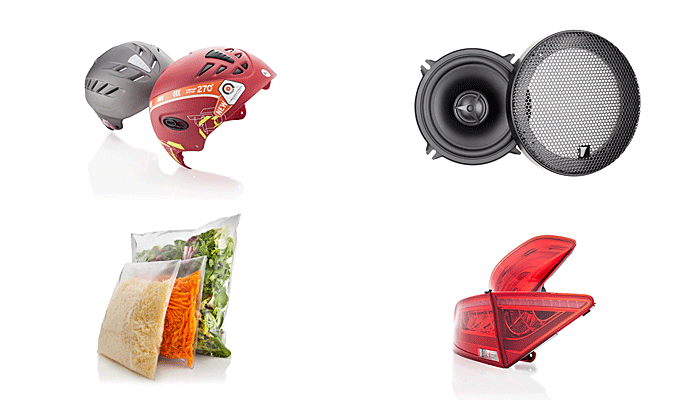
Die Ultraschall-Technologie ist, im Vergleich zu anderen thermischen Verfahren, schnell, effizient und umweltfreundlich bei der Bearbeitung von thermoplastischen Kunststoffen, Folien und Geweben. Unsere Produkte werden in allen kunststoffverarbeitenden Industrien eingesetzt, zum Beispiel Automobil Interieur und Exterieur, Filtration, Hygiene, technische Textilien, Verpackung, aber auch in der Umwelttechnologie.
Wie funktioniert der Ultraschall?
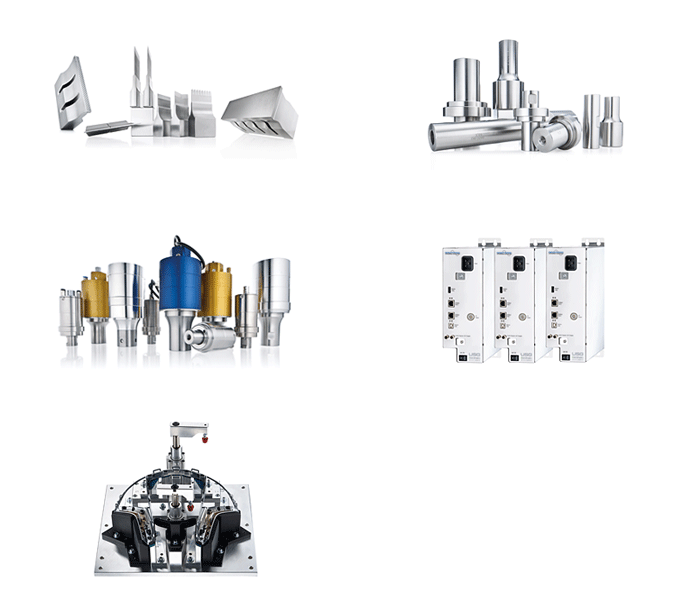
Die Ultraschall-Frequenz wird in einem Generator erzeugt. Der Generator wandelt Netzspannung in hochfrequente Hochspannung um und überträgt diese zum Schwinggebilde, das aus dem Konverter, dem Booster (Amplitudentransformationsstück) und der Sonotrode (Schweißwerkzeug) besteht. Der Konverter wandelt die ankommende Spannung elektrostriktiv in mechanische Schwingungen gleicher Frequenz und leitet diese über Booster und Sonotrode in das Werkstück. Durch Absorption der Schwingungen entsteht bei Druckbeaufschlagung und senkrechter Einleitung der mechanischen Schwingungen Grenzflächen- und Molekularreibung in der Füge- oder Trennzone. Das Resultat ist eine lokale Erwärmung des Werkstückmaterials in der Fügezone. Diese Plastifizierung ermöglicht, dass ein oder mehrere Werkstücke getaktet oder kontinuierlich geschweißt, gestanzt, genietet oder geprägt werden können.
Darüber hinaus bietet Ultraschall mit der Behandlung von Biofeststoffen eine weitere Anwendung in der Umwelttechnologie: Anstelle der lokalen Erwärmung erzeugt Ultraschall in den Flüssigkeiten intensive Kavitationsblasen. Die Implosion der Kavitationsblasen beeinträchtigt die Flüssigkeit und setzt damit z.B. biologische Masse besser um bzw. entkeimt sie.
Der Ultraschall-Generator erzeugt die elektrischen Ultraschall-Schwingungen: Dazu hebt er die Netzspannung von 230 Volt auf ca. 1.200 Volt an. Zusätzlich steigert der Generator die Frequenz der Wechselspannung von 50 Hertz auf 20.000 bis 35.000 Hertz. Er überträgt diese auf das Schwinggebilde, das aus einem Konverter, einem Booster (Amplitudentransformationsstück) und einer Sonotrode besteht.
Der Konverter wandelt die ankommenden elektrischen Schwingungen in mechanische Schwingungen gleicher Frequenz um. Über den Booster, der die mechanische Schwingung gleich hält oder verstärkt, gelangt sie in die Sonotrode. Die Sonotrode ist das eigentliche Schweißwerkzeug, sie bewegt sich 20.000 bis 35.000 Mal pro Sekunde um wenige Mikrometer und leitet die Ultraschallschwingungen in das Bauteil ein.
Bei senkrechter Einleitung der mechanischen Schwingungen und unter Zufuhr von Druck nimmt der Kunststoff die Schwingungen in der Fügezone auf. Diese Reibung in der Grenzfläche und den Molekülen bewirkt in der Fügezone des Materials eine lokale Erwärmung, sodass ein oder mehrere Werkstücke mit Ultraschall verschweißt, vernietet, geschnitten oder gestanzt werden können.
Technologien
Ultraschall-SchweißenAnmeldung zur Schulung
Wir bieten Schulungen für den qualifizierten Einsatz unserer Technologien und Maschinen am Firmenstandort in Karlsbad, per Webinar oder bei Ihnen vor Ort.
Welche Frequenz hat Ultraschall?
Ultraschall ist eine mechanische Schwingung mit einer Frequenz von 16 kHz bis 1 GHz. Schall unterhalb von 20 kHz ist für den Menschen wahrnehmbar und wird deshalb als Hörschall bezeichnet. Frequenzen über 500 kHz sind Hyperschall. Für den industriellen Einsatz in der Kunststoffbearbeitung ist Ultraschall im niedrigen Frequenzbereich von 20 kHz bis 100 kHz nutzbar. Die Ultraschall-Systeme von SONOTRONIC arbeiten mit 20 kHz, 30 kHz oder 35 kHz.
Welche Kunststoffe lassen sich mit Ultraschall bearbeiten?
Kunststoffe bestehen aus polymerisierten Kohlenwasserstoffen. Die Makromoleküle der Kunststoffe liegen nebeneinander mehr oder weniger verknäuelt vor und sind untereinander nicht vernetzt (Thermoplaste), schwach vernetzt (Elastomere) oder stark vernetzt (Duroplaste). (Quelle: www.kunststoffe.de)
Thermoplaste (Plastomere) sind als einzige Kunststoffe schweißbar
Thermoplaste sind Kunststoffe, die in einem bestimmten Temperaturbereich verformbar sind. Dies erfolgt durch Erwärmung bis in den schmelzflüssigen Zustand. Außerdem kann die Verformung beliebig oft (reversibel) durch Abkühlung und Wiedererwärmung wiederholt werden. Thermoplaste werden hauptsächlich für Spritzgussteile und extrudierte Teile verwendet. Nicht mit Ultraschall schweißbar sind Duroplaste und Elastomere.
Thermoplaste sind in amorphe und teilkristalline Kunststoffe unterteilt
Als amorph (griech. = ohne Gestalt) werden solche Kunststoffe bezeichnet, deren Moleküle nicht in regelmäßigen Kristallgittern angeordnet sind. Teilkristallin sind Kunststoffe, die in ihrer morphologischen Struktur, sowohl geordnete, kristalline als auch amorphe Bereiche besitzen (Quelle: Grundwissen Kunststoffe).
Amorphe Kunststoffe
Amorphe Kunststoffe sind in der Regel hart und haben einen günstigen Übertragungskoeffizienten für Ultraschall-Schwingungen. Aus diesem Grund ist es möglich, die eingeleitete Energie über größere Entfernungen bis an die Nahtstelle zu bringen. Für die Bearbeitung von amorphen Kunststoffen wird weniger Energie benötigt, im Vergleich zu teilkristallinen Kunststoffen.
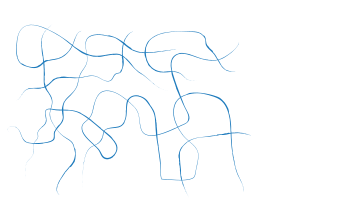
Fadenmoleküle von amorphen Thermoplasten
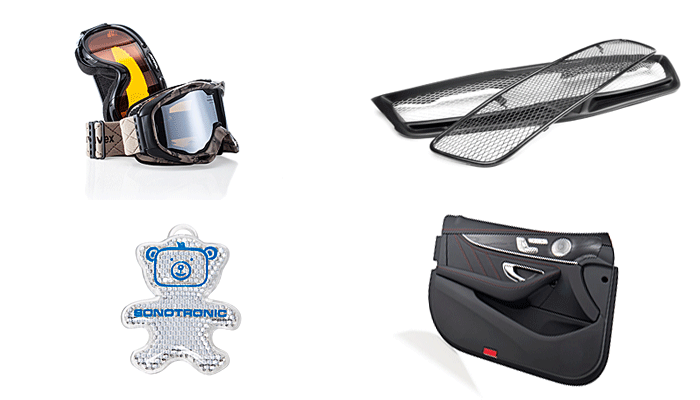
Beispiele amorphe Thermoplaste
ABS (Acrylnitril-Butadien-Styrol-Copolymer)
- Autotür
- Armaturenträger
- Spoiler
- Radkappen
PMMA (Polymethylmethacrylat)
- Reflektoren an Fahrradrädern
- Flugzeugscheiben
- Aufbiss-Schienen in der Zahntechnik
- Verkehrsschilder
PC (Polycarbonat)
- Brillengläser
- CDs
- Visiere (Skibrillen oder Helme)
ASA (Acrylnitril-Styrol-Acrylat-Copolymer)
- Außenverkleidungsteile (Auto)
- Garagentore
- Klimaanlagengehäuse
Teilkristalline Kunststoffe
Teilkristalline Kunststoffe sind Polymere, deren Moleküle die Tendenz haben, sich in der Übergangsphase zwischen flüssigem und festem Zustand in „Bausteine“ eines Kristallgefüges einzuordnen. Sie haben einen ungünstigen Übertragungskoeffizienten für Ultraschall-Schwingungen, deshalb sind keine oder nur bedingte Fernfeldschweißungen möglich.

Fadenmoleküle von teilkristallinen Thermoplasten
Beispiele teilkristalline Thermoplaste
PA (Polyamid)
- Lampengehäuse
- Kraftstoffleitung im Auto
- Ausgleichsbehälter im Auto
- Gas-/Bremspedal im Auto
POM (Polyoxymethylen)
- Tanks
- Griffe im Möbelbau
- Küchenbeschläge
- Lautsprechergitter
PP (Polypropylen)
- Fahrradhelme
- Folien/Verpackungen in der Lebensmittelindustrie
- Stoßfänger
PE (Polyethylen)
- Folien/Verpackungen in der Lebensmittelindustrie
- Einfache Spritzgussteile wie Kanister oder Rohre
- Orthopädische Korsagen